
How to Use an Induction Stove — First-Time User Guide Nepal
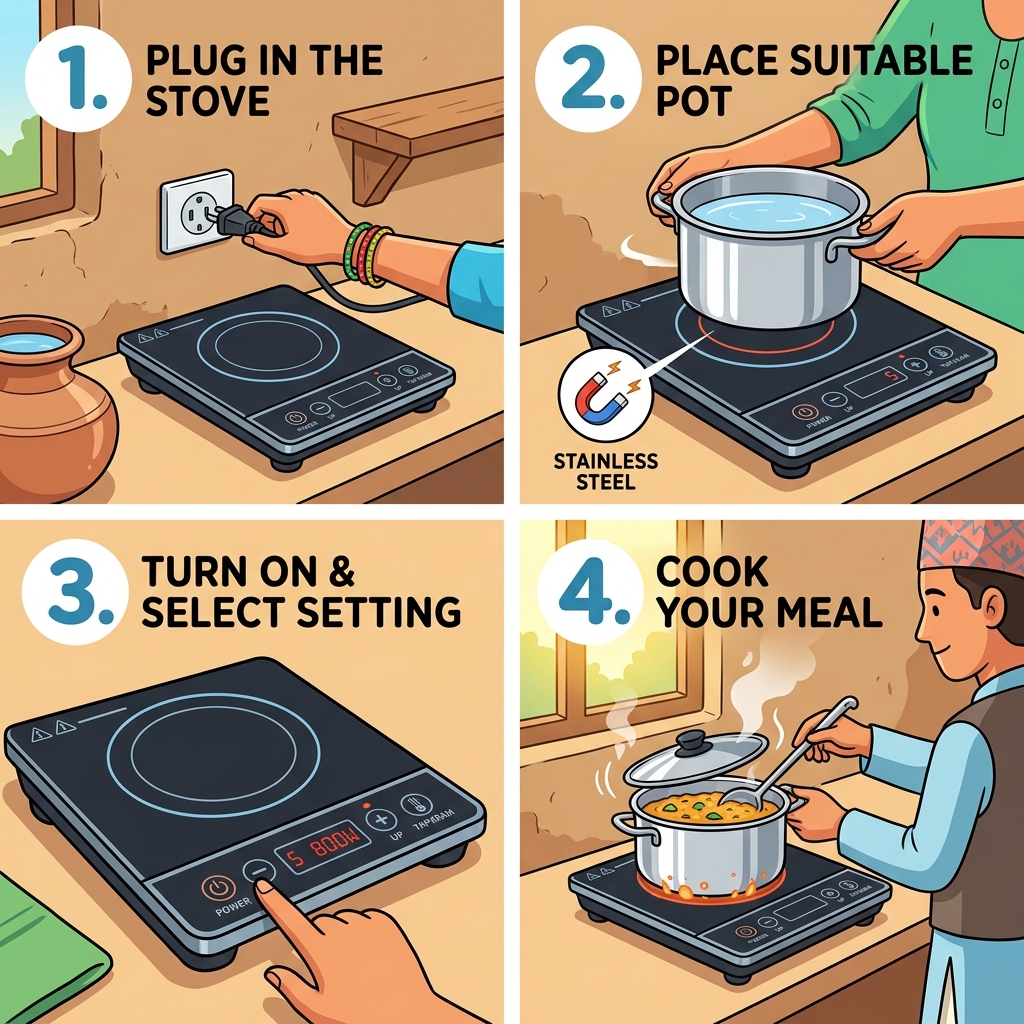
If you just received your induction stove, this guide covers everything: setup, first use, daily cooking tips, and what NOT to do to avoid damage. Written for Nepal’s most common cooking patterns.
Unboxing and Setup — First 10 Minutes
What’s in the Box
- Induction cooktop unit
- Power cord (usually attached)
- User manual (in English/Hindi — key sections translated below)
Placement
- Place on a flat, stable, heat-resistant surface — marble or granite countertop is ideal
- Minimum 10cm clearance on all sides for ventilation
- Do NOT place on top of wooden shelves, tablecloths, or directly on the floor
- The plug requires a 3-pin grounded socket (standard in Nepal) — do NOT use a 2-pin adapter
First Power-On
Daily Cooking Guide — Nepal Specific
Boiling Water / Milk (Most Common Task)
Cooking Rice (Bhat)
Dal (Lentils)
Deep Frying (Sel Roti, Pakoda, Puri)
Pressure Cooking (Keema, Mutton, Aloo)
Control Panel — Button Functions Explained
Most Nepal-market induction stoves share this button layout:
| Button | Function |
|---|---|
| Power / ON-OFF | Start / Stop the stove |
| + / − | Increase / decrease power or temperature |
| Timer | Set a countdown (press timer, then + to set minutes) |
| Preset buttons (Milk, Water, Fry, Rice, etc.) | One-press cooking modes |
| Child Lock (long-press) | Hold for 3 seconds to lock / unlock all buttons |
Timer Function
- Press Timer
- Press + to add minutes (usually in 10-min increments)
- Timer counts down → auto shuts off when time expires → usually beeps 3 times
What NOT to Do — Avoid These Mistakes
| ❌ Don’t | Why |
|---|---|
| Use aluminum kadhai or copper vessels | No magnetic base — stove won’t detect cookware, won’t heat |
| Place empty pot on maximum power | Can crack glass or warp cookware base |
| Slide heavy pots across the surface | Scratches the glass ceramic |
| Cover the ventilation grill (underside/back) | Overheats the internal coil — triggers auto-shutoff or permanent damage |
| Use near water or wet surfaces | Electrical hazard |
| Leave spilled liquid on the surface while heating | Can create hot spots on glass |
[Error Codes](/induction-cooker-error-codes/) — What They Mean
| Code | Meaning | Fix |
|---|---|---|
| E0 / E1 | No cookware detected | Place a compatible pot on the zone |
| E6 | Overheating | Remove pot, let cool 5 min, restart |
| E7 / E8 | Voltage too low (<180V) or too high (>260V) | Wait for stable power supply |
| E9 | Internal sensor fault | Unplug for 10 min, retry |
Cleaning After Each Use
Frequently Asked Questions — Nepal Users
Q: Can I use my old dekchi on the induction stove?
A: Only if it has a flat base and magnetic metal. Test with a fridge magnet — if it sticks firmly, it works.
Q: The stove makes a humming sound — is that normal?
A: Yes. The oscillating magnetic field causes the cookware to vibrate slightly. Louder hum = higher power setting. This is normal.
Q: The glass cracked. What happened?
A: Most glass cracking is caused by thermal shock — placing a very cold pot on a hot surface, or a boiling liquid spill on hot glass. Always handle glass surfaces gently.
Q: Does it work during low voltage / load shedding?
A: Most Nepal-market induction stoves tolerate 180V–240V. Below 180V, they auto-shutoff (E7/E8 error) to protect the circuit. CG and Yasuda models are specifically engineered for Nepal’s grid.
