
Government Subsidy for Induction Stove Nepal 2026 — NEA Discount Guide
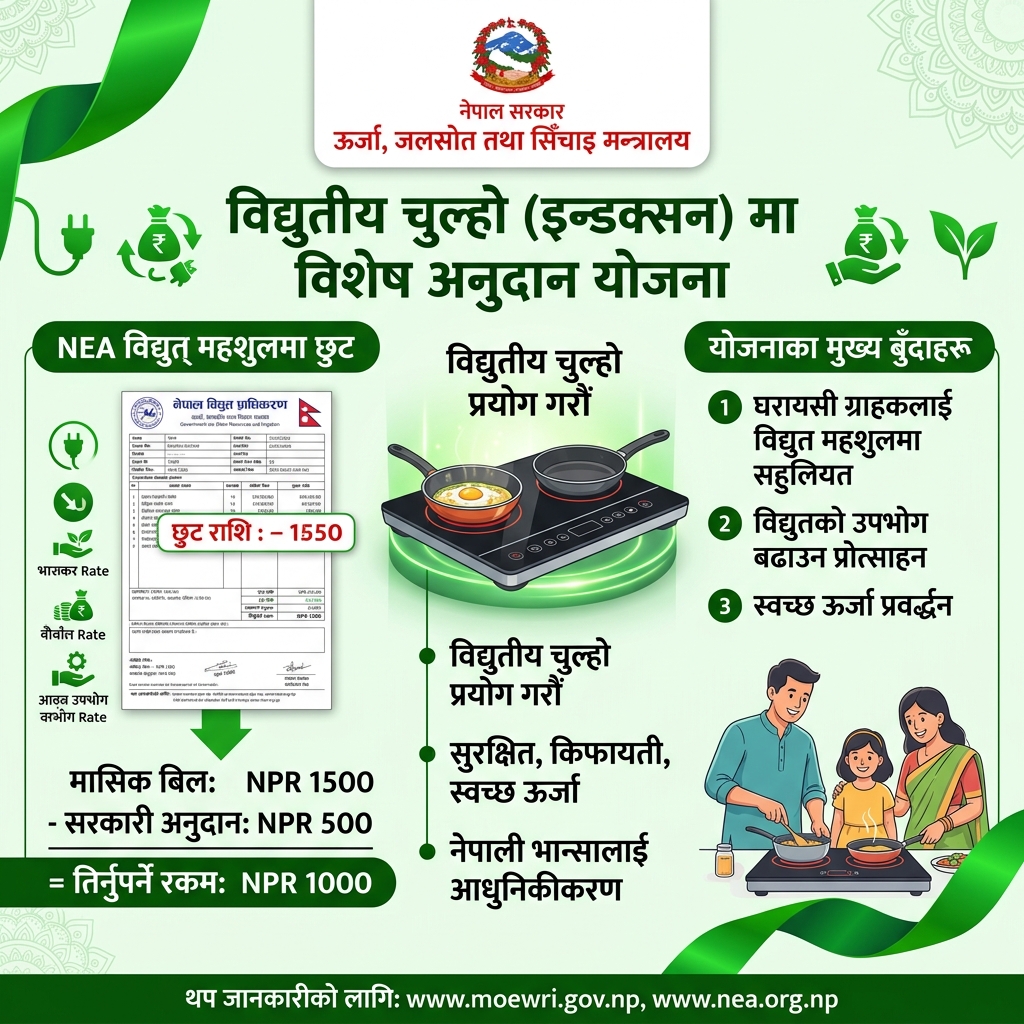
Nepal’s government has formally adopted electric cooking as national energy policy under the Energy White Paper and the Alternative Energy Promotion Centre (AEPC) clean cooking mandate. This has resulted in multiple active subsidy and incentive programs that reduce the cost of induction stove ownership in Nepal.
NEA Electricity Discount — The Most Impactful Subsidy
The Nepal Electricity Authority (NEA) offers a 20% discount on electricity bills for the first 150 units consumed per month for households registered as electric cooking users.
Who Qualifies?
- Any household that formally declares electric cooking as primary cooking method to NEA
- Must apply at your local NEA office with proof of residence
- Single connection per household
What Is the Saving?
At current NEA retail rates:
| Monthly Units (Cooking) | Normal Tariff | With 20% Discount | Monthly Savings |
|---|---|---|---|
| 80 units | रु. 590 | रु. 472 | रु. 118 |
| 120 units | रु. 950 | रु. 760 | रु. 190 |
| 150 units | रु. 1,250 | रु. 1,000 | रु. 250 |
Over 12 months, this discount alone saves रु. 1,400–3,000 annually — partially recovering the cost of a mid-range induction stove.
AEPC Clean Cooking Programme
The Alternative Energy Promotion Centre (AEPC) under the Ministry of Energy, Water Resources and Irrigation manages Nepal’s clean cooking transition. Key activities relevant to induction stove buyers:
Subsidized Induction Kits for Rural Households
AEPC periodically runs programs providing subsidized induction cooktops + compatible cookware to rural and peri-urban households. Subsidies range from 20–50% of product cost for eligible households.
How to Apply:
- Contact your District Coordination Committee (DCC) office
- Contact AEPC directly: aepc.gov.np
- Check with local cooperative societies participating in the programme
Nepal Electricity Regulatory Commission (NERC) — Tariff Structure
Understanding NERC’s electricity tariff structure helps calculate actual induction cooking costs:
| Monthly Consumption | Rate per Unit |
|---|---|
| 0–20 units | रु. 3.00 |
| 21–30 units | रु. 6.50 |
| 31–100 units | रु. 8.00 |
| 101–250 units | रु. 9.50 |
| Above 250 units | रु. 11.00 |
With the NEA 20% electric cooking discount applied on the first 150 units, a household consuming 120 units for cooking pays approximately रु. 760–800/month total.
National Energy Crisis Resolution and Energy Development Decade Plan
Nepal’s government has targeted 95% household electrification by 2030 and has explicitly included electric cooking as a core strategy. Implications for induction stove buyers:
Does the Government Provide Direct Cash Subsidies on Induction Stoves?
As of March 2026, no universal direct cash subsidy exists for individual induction stove purchases in Nepal. The benefits are:
Practical Steps to Claim NEA Discount
– Electricity meter number
– Proof of residence (citizenship/rental agreement)
– Induction stove purchase receipt
Process time: 1–7 working days in most offices.
Summary: True Cost of Induction Cooking After Government Benefits
| Cost Factor | Amount |
|---|---|
| Induction stove purchase (mid-range, 2000W) | रु. 3,800–5,500 |
| Monthly electricity cost (2 hrs/day) | रु. 700–900 |
| Less: NEA 20% discount | −रु. 140–190 |
| Net monthly electricity cost | रु. 560–750 |
| Monthly LPG savings | रु. 900–1,700 |
| Net monthly saving vs LPG | रु. 150–950 |
| Payback period on stove purchase | 4–8 months |
The combination of electricity savings and NEA discount makes an induction stove Nepal’s most economical primary cooking appliance for urban and semi-urban households.
Compare prices from online retailers — Browse online prices →
