
Induction vs Gas Stove Nepal 2026 — Cost, Safety and Performance
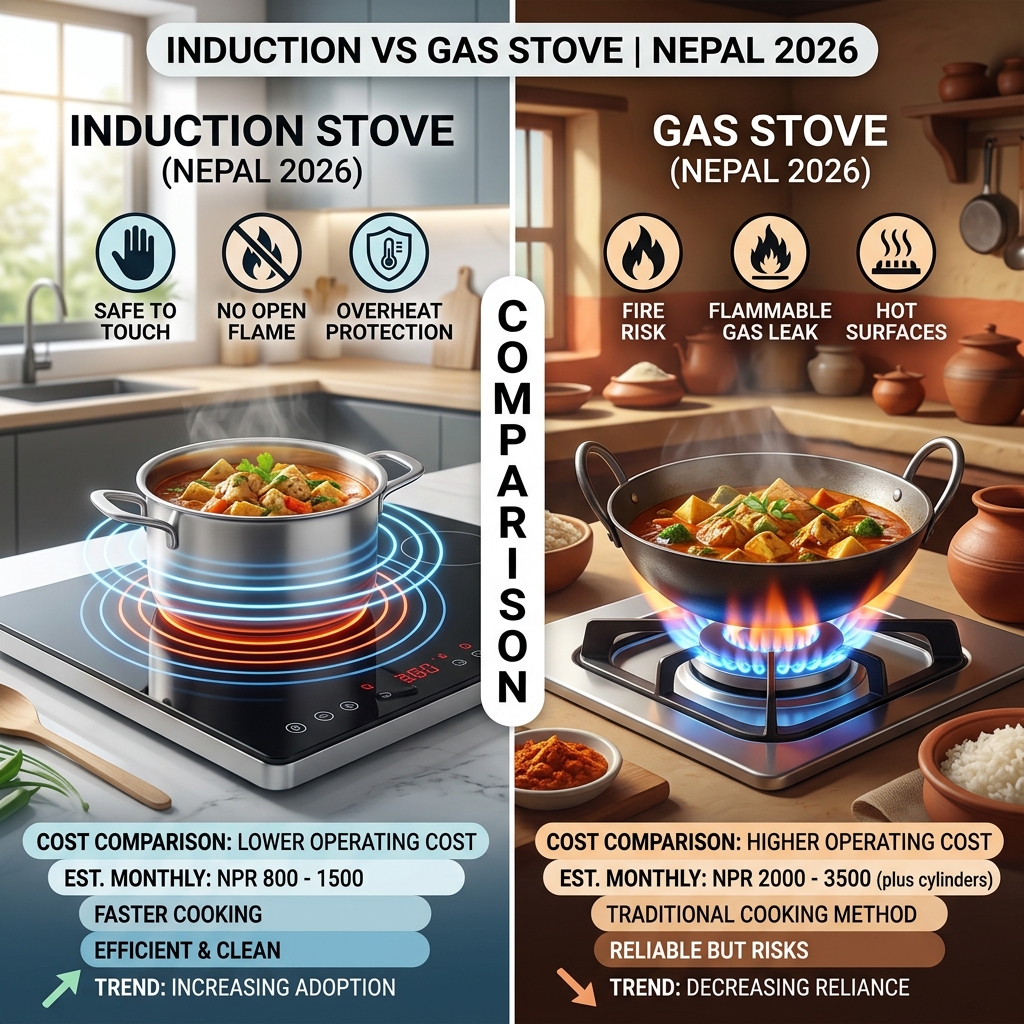
Induction stoves save Nepal families рū. 710 to рū. 1,665 per month compared to LPG gas stoves — verified against Nepal Oil Corporation’s official LPG cylinder price of рū. 1,910 (March 2026) and Nepal Electricity Authority’s household tariff rates. Induction stoves heat faster, produce zero indoor air pollution, and eliminate LPG cylinder dependency. LPG gas stoves offer wider cookware compatibility, work during power outages, and require no initial cookware investment. This comparison uses Nepal-specific costs, availability, and cooking patterns — not global assumptions.
Source: Nepal Oil Corporation — LPG рū. 1,910/cylinder rate, March 2026
Source: NEA — household electricity tariff slabs, nea.org.np
Monthly Cost Comparison — Induction vs LPG in Nepal
| Cost Factor | LPG Gas Stove | Induction Stove |
|---|---|---|
| Monthly fuel/electricity | рū. 1,910 – рū. 2,865 (1-1.5 cylinders) | рū. 700 – рū. 1,200 (60-100 kWh) |
| Annual fuel cost | рū. 22,920 – рū. 34,380 | рū. 8,400 – рū. 14,400 |
| Stove purchase price | рū. 2,500 – рū. 8,000 (2-burner LPG) | рū. 2,999 – рū. 10,999 (single burner) |
| Cookware investment | рū. 0 (existing cookware works) | рū. 1,500 – рū. 4,000 (if replacing aluminum) |
| Monthly savings (induction) | — | рū. 710 – рū. 1,665/month |
| Payback period | — | 3-6 months |
A Baltra Active BIC-124 at рū. 2,999 pays for itself within 2 to 4 months through LPG savings alone. A mid-range CG CGIC20D02 at рū. 4,600 to рū. 5,400 pays for itself within 3 to 6 months. Even accounting for induction-compatible cookware investment (рū. 1,500 to рū. 4,000), the total switching cost to induction is recovered within 6 to 10 months.
Cooking Performance — Speed, Heat Control, and Nepal Meals
Boiling Speed
A 2000W induction stove boils 1 liter of water in approximately 4 to 5 minutes. A standard LPG burner boils the same volume in approximately 6 to 8 minutes. Induction’s electromagnetic heating transfers energy directly to the cookware with minimal heat loss — LPG flame heats the air around the pot as well as the pot itself, losing 40 to 50% of heat energy to the surrounding kitchen environment.
Pressure Cooking Dal
Nepal families cook dal in pressure cookers daily — typically 3 to 5 whistles for standard lentil preparation. Induction stoves reach pressure faster due to more efficient heat transfer, reducing total pressure cooking time by 2 to 4 minutes per batch compared to LPG. The Prestige PIC 6.1 V3 (рū. 7,400+) includes an automatic whistle counter — no LPG stove offers this feature.
Temperature Control
Induction stoves offer precise digital temperature control — set exact wattage levels from 200W (gentle simmering) to 2000W (full power boiling). LPG stoves offer analog flame control that varies based on gas pressure in the cylinder — as the cylinder empties, flame intensity drops. For dishes requiring precise low-heat simmering (like kheer, achar preparation, or momo sauce), induction delivers more consistent results.
Safety Comparison for Nepal Homes
| Safety Factor | LPG Gas Stove | Induction Stove |
|---|---|---|
| Fire risk | 🔴 High — open flame | 🟢 None — no flame |
| Gas leak risk | 🔴 Present — regulator/hose failures | 🟢 None — no gas |
| Surface temperature | 🔴 Grate and flame area extremely hot | 🟢 Glass stays relatively cool |
| Child safety | 🔴 Open flame + hot grate | 🟢 Cool surface + child lock option |
| Indoor air pollution | 🔴 CO, NO₂ emissions from combustion | 🟢 Zero emissions |
| Earthquake safety | 🔴 Gas line rupture risk | 🟢 No gas infrastructure |
| Power outage | 🟢 Works without electricity | 🔴 Does not work |
Nepal’s seismic risk makes gas leak safety relevant — the 2015 Gorkha earthquake demonstrated how LPG infrastructure (cylinders, regulators, hose connections) poses fire risk during and after seismic events. Induction stoves eliminate this risk entirely.
Cookware Compatibility
LPG gas stoves work with every type of cookware — aluminum, copper, glass, steel, iron, round-bottom, flat-bottom. Nepal’s most common household cookware (aluminum pressure cookers, aluminum dekchis, round-bottom kadhais) all work on gas.
Induction stoves require flat-bottom cookware with a magnetic (steel or iron) base. Nepal buyers switching from gas to induction must audit their existing cookware with a magnet test — hold a refrigerator magnet to the bottom of each pot. If the magnet sticks firmly, the pot works. If not, it must be replaced. Budget рū. 1,500 to рū. 4,000 for a basic induction-compatible set if your existing cookware fails the test. See our induction cookware guide for Nepal-specific options and prices.
Alternative: Infrared cookers (рū. 3,900 to рū. 5,275) work with all cookware types including aluminum — offering a middle path for Nepal families wanting electric cooking without cookware replacement.
Nepal-Specific Factors
Electricity Availability
Nepal’s load-shedding era has largely ended — the country generates surplus hydropower electricity, and most urban areas (Kathmandu Valley, Pokhara, Biratnagar, Terai cities) receive 22 to 24 hours of daily power. Induction cooking is viable as a primary cooking method in these areas. Rural areas with less stable power supply should keep an LPG backup stove.
LPG Supply and Price Trends
Nepal Oil Corporation controls LPG pricing at рū. 1,910 per cylinder (March 2026). LPG prices have increased multiple times over the past decade and are subject to international petroleum market fluctuations. Electricity rates from NEA’s hydropower-based tariff system have been comparatively stable. The long-term cost trend favors electricity over imported LPG.
Government Policy Direction
The Nepal government has signaled a strategic shift toward electric cooking — maintaining a reduced 1% customs duty on induction stove imports (plus 13% VAT) while standard appliance import duties are higher. The Alternative Energy Promotion Centre (AEPC) has distributed free induction stoves to specific communities. While no general consumer subsidy exists, the policy direction favors continued incentivization of electric cooking. See our government subsidy guide for current policies.
Our Recommendation for Nepal Families
Most Nepal families benefit from a hybrid approach during the transition period:
This approach saves рū. 500 to рū. 1,000+ per month immediately (reduced LPG consumption) while maintaining cooking flexibility during the transition.
Frequently Asked Questions — Induction vs Gas Nepal
Can induction fully replace gas in Nepal?
Families of 2 to 4 members with stable electricity can fully replace LPG with a single-burner induction stove if comfortable with sequential cooking. Families of 5+ should either buy a double-burner CG CGDIC20G02 (рū. 11,600+) or keep a single LPG burner as backup for simultaneous cooking during high-volume meal preparation.
Is induction cooking healthier than gas?
Induction cooking produces zero combustion byproducts — no carbon monoxide (CO) or nitrogen dioxide (NO₂) emissions that LPG combustion releases into the kitchen. Studies show that gas cooking without adequate ventilation degrades indoor air quality, particularly in small Nepal apartment kitchens with limited cross-ventilation. Induction eliminates this health concern entirely.
What happens during load shedding?
Induction stoves do not work without electricity. In 2026, scheduled load shedding has ended in most Nepal urban areas, but unscheduled outages (30 minutes to 2 hours) occur occasionally. Keeping one LPG burner specifically for backup cooking during outages costs рū. 0 in standing cost (no monthly cylinder if only used for emergencies) and provides complete cooking continuity.
Last updated: March 2026. Fuel costs verified from NOC and NEA official rates.
📞 Switch to Induction — Order at InductionStoveNepal | 🚚 Free Delivery Kathmandu Valley | 💵 COD Available
Compare prices from online retailers — Browse online prices →
