
Infrared Cooker Price in Nepal 2026
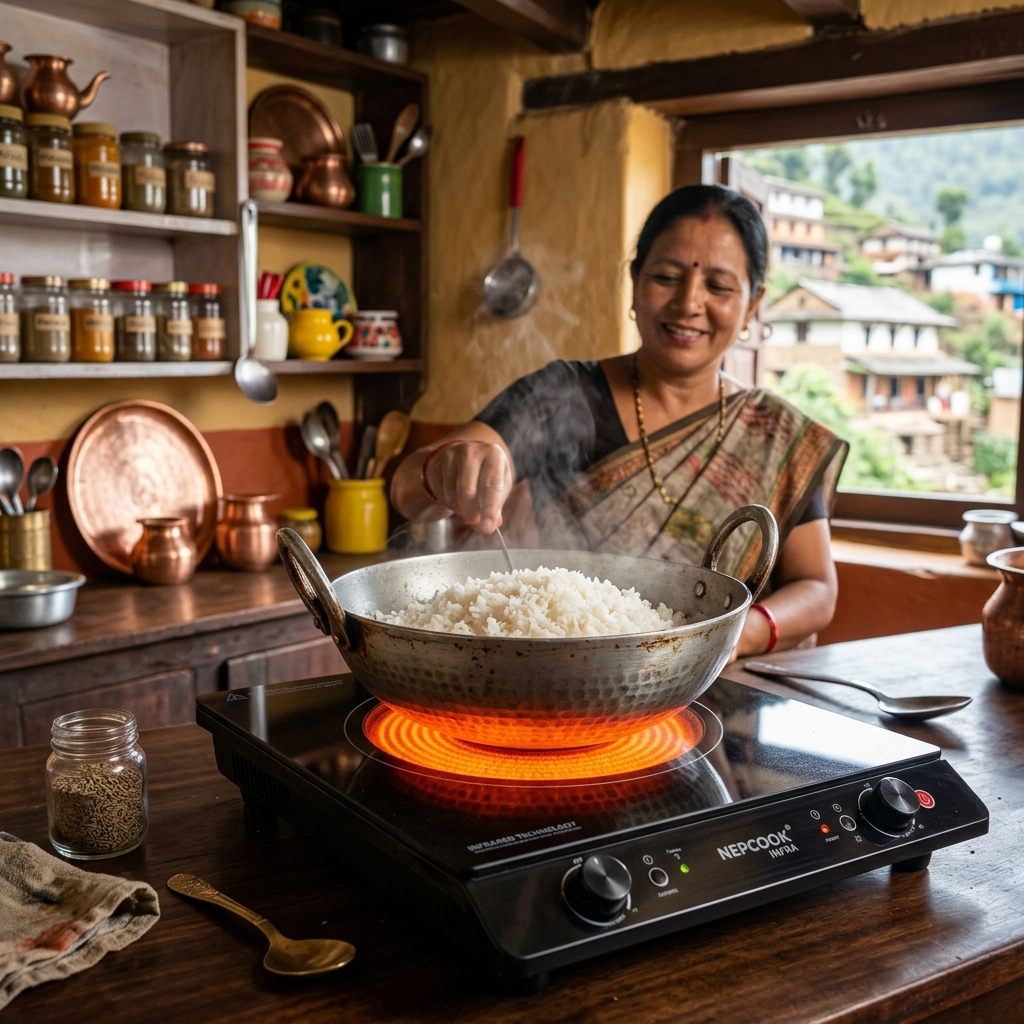
Infrared cookers in Nepal cost between रु. 3,900 and रु. 10,500. Single-burner models from Baltra range from रु. 4,575 to रु. 5,275, and Yasuda single-burner units cost रु. 3,900 to रु. 4,100. Dual-burner infrared cookers from Yasuda start at रु. 8,900. The biggest advantage of infrared over induction is cookware compatibility — infrared works with all flat-bottom cookware including aluminum, copper, and glass. Nepal families that already own non-magnetic cookware can switch to electric cooking without buying new pots. At InductionStoveNepal, we carry infrared cookers alongside induction models — order with free Kathmandu delivery, COD, and 1-year warranty.
Source: Daraz.com.np, ACGhar.com — product listings verified March 2026
Infrared Cooker [Price List Nepal](/induction-stove-price-in-nepal/) 2026 — All Brands
| Brand | Model Type | Burners | Wattage | Price Range (रु.) | Controls |
|---|---|---|---|---|---|
| Yasuda | YS-IFMT20 | Single | 2000W | 3,900 – 4,100 | Touch |
| Baltra | Feel / Smart Cook series | Single | 2000W | 4,575 – 5,275 | Touch |
| Baltra | Sensible / Ready Cook | Single | 2000W | 4,700 – 5,275 | Touch |
| Yasuda | YS-IFMD40 | Double | 4000W | 8,900 – 10,500 | Touch |
| Baltra | Various double models | Double | 3500-4000W | 9,000 – 11,000 | Touch |
Infrared cookers are generally priced ру. 500 to рु. 2,000 higher than equivalent-wattage induction stoves from the same brand. The price premium reflects the radiant heating element construction and the wider cookware compatibility.
Source: Daraz.com.np — infrared cooker category listings, March 2026
Single-Burner Infrared Cookers — रु. 3,900 to रु. 5,275
Single-burner infrared cookers suit Nepal households that want electric cooking without replacing their existing aluminum and copper cookware. Every single-burner infrared model below operates at 2000W — the same power rating as standard induction stoves.
Yasuda Infrared Cookers — रु. 3,900 to रु. 4,100
Yasuda single-burner infrared cookers cost between रु. 3,900 and रु. 4,100 in Nepal as of March 2026 — making Yasuda the most affordable brand for infrared cooking. The Yasuda YS-IFMT20 delivers 2000W power with touch controls and standard safety features including overheat protection and auto shutoff.
Yasuda is a Nepali brand with domestic warranty processing — warranty claims go through Yasuda’s own Nepal-based service network rather than international importer channels. For Nepal buyers outside Kathmandu Valley, Yasuda’s local service access is a practical advantage over imported brands.
Best for: Budget-conscious Nepal families switching from LPG to electric cooking who do not want to replace their aluminum cookware. The ру. 3,900 entry price, combined with zero cookware replacement cost, makes Yasuda infrared the lowest total cost of switching to electric cooking in Nepal.
Source: Daraz.com.np — Yasuda YS-IFMT20 listing, March 2026
[Baltra Infrared Cooker](/baltra-infrared-cooker/)s — रु. 4,575 to रु. 5,275
Baltra single-burner infrared cookers range from रु. 4,575 to रु. 5,275 across Nepal retailers as of March 2026. Baltra’s infrared lineup includes the Feel, Smart Cook, Sensible, and Ready Cook models — all operating at 2000W with touch controls, overheating protection, and child lock features.
Baltra infrared models cost approximately ру. 500 to ру. 1,000 more than Yasuda equivalents at the same wattage. The premium buys Baltra’s wider model selection (including variants with grill attachments), tempered glass panel quality, and the Baltra brand reputation that Nepal buyers already know from the brand’s popular induction cooker range.
Best for: Nepal families who want a recognized brand with multiple model options. The grill-attachment variants are useful for households that prepare grilled items (momo, kebabs, vegetables) — a functionality that neither standard infrared nor induction cookers typically offer.
Source: Daraz.com.np — Baltra infrared cooker listings, March 2026
Double-Burner Infrared Cookers — रु. 8,900 to रु. 10,500
Double-burner infrared cookers allow Nepal families to cook two dishes simultaneously using their existing cookware. The Yasuda YS-IFMD40 is the most commonly available double-burner infrared model in Nepal, priced between रु. 8,900 and ру. 10,500 with a combined 4000W power output across two independent heating zones.
Yasuda YS-IFMD40 Double Infrared — रु. 8,900 to रु. 10,500
The Yasuda YS-IFMD40 delivers 4000W total power through two independent burner zones, each controllable separately for temperature and timer settings. The double-burner format eliminates the sequential cooking problem — simmer dal on one side while frying tarkari at full power on the other. For large Nepal families (5+ members) who want to eliminate LPG entirely without buying induction-compatible cookware, the Yasuda double infrared represents the most practical all-electric cooking solution.
Important electrical note: A 4000W double-burner infrared cooker draws approximately 17 amps at 230V. Nepal households must verify their meter capacity before purchasing — most standard 5-amp meters cannot support this load. A 15-amp or 30-amp meter connection is required. Consult your electrician or local NEA office.
Price comparison with induction: The CG CGDIC20G02 double-burner induction stove costs ру. 11,600 to ру. 12,400 — approximately ру. 1,500 to рु. 3,000 more than the Yasuda double infrared. The choice between the two depends entirely on cookware: if your existing cookware passes the magnet test, choose induction (more energy efficient). If your cookware is aluminum or copper, choose infrared.
Source: Daraz.com.np, Dealayo.com — Yasuda YS-IFMD40 listings, March 2026
Infrared vs Induction — Which Should Nepal Buyers Choose?
This is the most common question Nepal buyers ask when considering electric cooking. The answer depends on two factors: your existing cookware and your energy efficiency priority.
| Factor | Infrared | Induction |
|---|---|---|
| Cookware compatibility | ✅ All flat-bottom — aluminum, copper, glass, steel, iron | ❌ Magnetic base only — steel and iron |
| Energy efficiency | Moderate — heat radiates outward from the coil | High — electromagnetic energy heats only the pot |
| Surface temperature | 🔴 Very hot — glass retains heat 10-15 min after cooking | 🟢 Relatively cool — glass does not generate heat |
| Heating speed | Slower — gradual radiant heating | Faster — direct electromagnetic heating |
| Safety for children | Lower — hot glass surface risk | Higher — cool glass surface + auto-pan detection |
| Price range (Nepal) | रु. 3,900 – रु. 10,500 | रु. 2,999 – रु. 12,400 |
| Monthly [electricity cost | रु. 800 – रु. 1,400/month](/induction-stove-electricity-cost-nepal/) | रु. 700 – रु. 1,200/month |
| Cookware replacement cost | रु. 0 (works with existing pots) | रु. 1,500 – रु. 4,000 for new cookware |
When to choose infrared:
- Your home has significant aluminum and copper cookware that you cannot replace
- The total switching cost matters — infrared рु. 3,900 stove + ру. 0 cookware = рू. 3,900 total vs induction рू. 2,999 stove + рू. 1,500 cookware = рू. 4,499 total
- You want to grill (Baltra infrared models with grill attachments)
- You cook foods that frequently spill — the radiant glass surface is easier to see spills on than induction’s cool glass
When to choose induction:
- Energy efficiency is a priority — induction uses approximately 10-20% less electricity for the same cooking
- You have children — the cooler glass surface and auto-pan detection add meaningful safety
- You are willing to invest in induction-compatible cookware
- You want faster heating and boiling times
InductionStoveNepal recommendation: For most Nepal families making a first-time switch from LPG to electric cooking, infrared is the lower-risk entry point because it works with existing cookware. Families can later transition to induction once they accumulate induction-compatible cookware over time. At our store, we carry both types and help customers choose based on their actual cooking setup. For a detailed technology comparison, see our Induction vs Infrared Cooktop guide.
How Much You Save vs LPG with Infrared
Infrared cooking saves Nepal families between ру. 500 and ру. 1,100 per month compared to LPG. The savings are slightly lower than induction (which saves ру. 700 to ру. 1,665/month) because infrared is less energy-efficient — more heat escapes around the cookware rather than being directed entirely into it.
| Cooking Method | Monthly Cost (रу.) | Annual Cost (рु.) |
|---|---|---|
| LPG Gas | रु. 1,910 – रु. 2,865 | रु. 22,920 – रु. 34,380 |
| Infrared Cooker | रु. 800 – रु. 1,400 | रु. 9,600 – रु. 16,800 |
| Monthly Savings | रु. 510 – рु. 1,465 | рु. 6,120 – ру. 17,580 |
A Yasuda infrared cooker at ру. 3,900 pays for itself within 3 to 5 months through LPG savings. No additional cookware investment is needed, making the total payback period among the fastest of any electric cooking option in Nepal.
Source: Nepal Oil Corporation — LPG price рु. 1,910 per cylinder, March 2026
Source: NEA — progressive slab tariff structure for electricity cost estimates
Safety Considerations for Infrared Cookers in Nepal
Infrared cookers have specific safety characteristics that Nepal buyers must understand before purchase:
Hot Glass Surface — The Primary Safety Concern
The glass surface of an infrared cooker reaches temperatures above 300°C during cooking and remains dangerously hot for 10 to 15 minutes after the cooker is turned off. This residual heat is the most significant safety difference between infrared and induction cookers. Nepal households with young children or elderly family members must plan cooker placement carefully — position the infrared cooker where it cannot be accidentally touched during or after cooking.
Overheating Protection
All branded infrared cookers (Baltra, Yasuda) sold in Nepal include automatic overheating shutoff — the cooker turns off if internal temperatures exceed safe thresholds. This prevents the heating element from damaging the glass panel. Do not disable or bypass this safety feature.
Proper Ventilation
Infrared cookers generate more ambient heat than induction models. Ensure at least 15cm clearance on all sides for ventilation. In small Nepal kitchen spaces, the additional ambient heat is noticeable during extended cooking sessions — especially during summer months.
Infrared Cooker Maintenance in Nepal
Cleaning the Glass Surface
Clean the glass surface after every cooking session once it has cooled completely. Use a soft, damp cloth — never pour water on a hot infrared glass surface as thermal shock can crack the panel. For stubborn food stains, use a mixture of baking soda and water applied with a soft cloth. Avoid abrasive scrubbers that can scratch the glass.
Protecting the Heating Element
The radiant heating coil inside the infrared cooker is durable but can be damaged by heavy impact — if a heavy pot is dropped directly on the cooking zone. Always place cookware gently on the surface. If the heating coil shows visible damage (warping, cracking, discoloration), discontinue use and request warranty service.
Frequently Asked Questions — Infrared Cooker Nepal
What is the difference between infrared and induction cooker?
Infrared cookers heat a radiant coil element that transfers heat through the glass surface to the cookware — the glass and the element both get very hot. Induction cookers use electromagnetic energy to heat only the cookware — the glass surface stays relatively cool. Infrared works with all flat-bottom cookware. Induction requires magnetic-base cookware only (steel, cast iron).
Can I use aluminum pots on an infrared cooker?
Aluminum pots with flat bottoms work on infrared cookers — this is the primary advantage over induction. Nepali households commonly use aluminum pressure cookers, aluminum kadhais, and aluminum dekchis that work on infrared but not on induction. Round-bottom cookware does not work on infrared because it cannot make stable contact with the flat glass cooking surface.
Is infrared cooking safe?
Infrared cooking is safe when used with proper precautions. The main safety risk is the hot glass surface — which remains dangerously hot for 10 to 15 minutes after cooking. All branded models (Baltra, Yasuda) include overheating protection and auto-shutoff. For households with small children, induction is the safer option because the glass surface stays relatively cool.
Which is cheaper in Nepal — infrared or induction?
The cheapest infrared cooker (Yasuda single рू. 3,900) costs approximately рू. 900 more than the cheapest induction (Baltra Active рू. 2,999). However, infrared requires no cookware replacement while induction may require рू. 1,500 to рू. 4,000 in new cookware. Total switching cost: infrared ~рू. 3,900 vs induction ~рू. 4,499 to рू. 6,999 (stove + cookware). Infrared wins on total initial cost but loses on monthly electricity efficiency.
How long does an infrared cooker last?
Branded infrared cookers from Baltra and Yasuda carry a standard 1-year manufacturer warranty. The heating element and glass panel are the two components subject to wear. With proper use — gentle cookware placement, regular cleaning after cooling, surge-protected power connection — a well-maintained infrared cooker serves a Nepal household well beyond the warranty period.
Does InductionStoveNepal sell infrared cookers?
InductionStoveNepal carries both induction and infrared cookers from Baltra, Yasuda, and other brands available in Nepal. We recommend the right cooking technology based on each customer’s existing cookware and cooking needs — we do not push one technology over the other. Order infrared cookers with the same free Kathmandu delivery, COD, and warranty that we offer on all induction models.
Last updated: March 2026. All prices verified from Daraz Nepal and authorized retailers.
📞 Order Now at InductionStoveNepal | 🚚 Free Delivery Kathmandu Valley | 💵 COD Available | 🛡️ 1-Year Warranty
