
How Does an Induction Cooker Work?
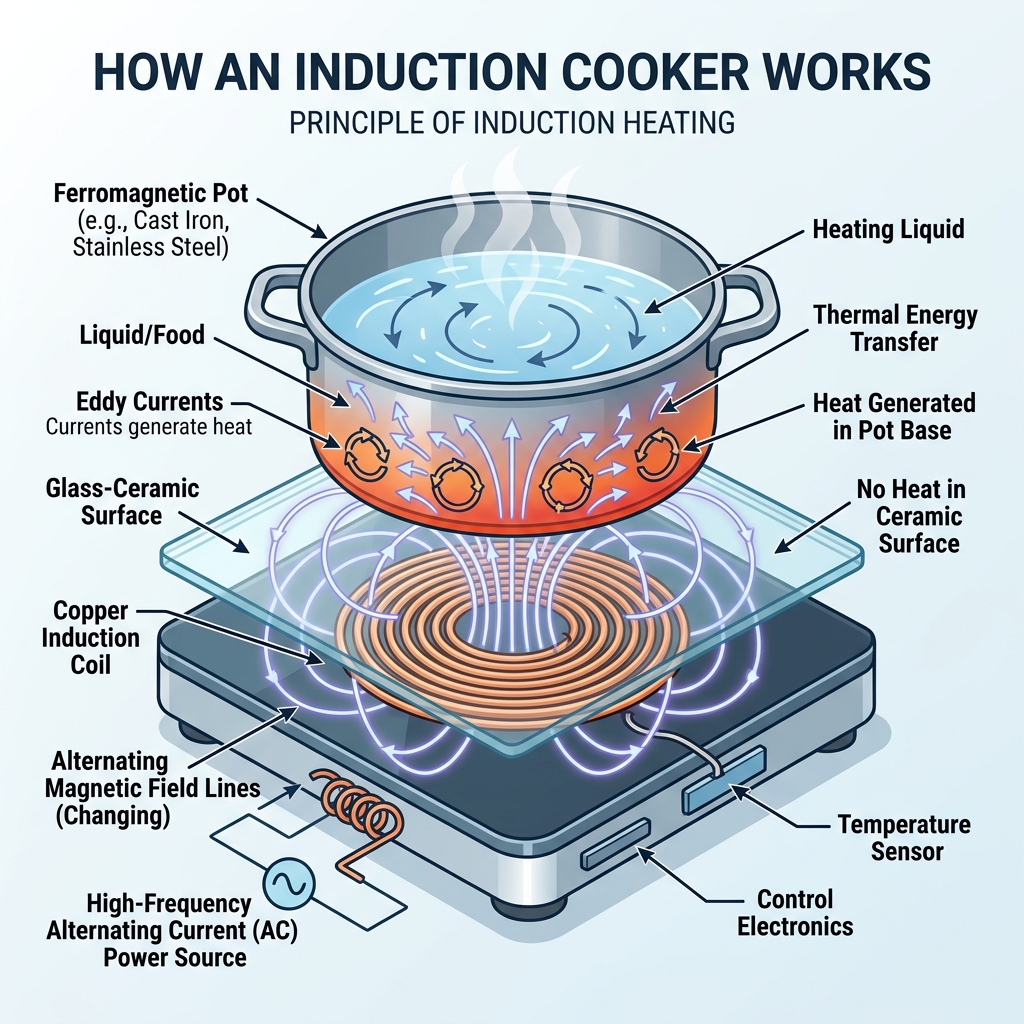
An induction cooker heats food by generating an electromagnetic field beneath the glass surface that transfers energy directly into the cookware’s magnetic metal base. The glass surface itself does not generate heat — only the pot or pan heats up. This is why induction requires flat-bottom steel or iron cookware (magnetic materials) and why aluminum, copper, and glass cookware does not work. Understanding this mechanism helps Nepal buyers avoid the most common induction purchase mistake: buying the stove without checking cookware compatibility first.
The 3-Step Heating Process
Step 1: Electricity Powers a Copper Coil
Inside every induction cooker — the Baltra Active BIC-124 at рū. 2,999, the CG CGIC20D02 at рū. 4,600, or the Philips HD4928 at рū. 10,349 — a flat copper coil sits beneath the glass surface. When the stove is powered on, alternating electric current flows through this coil at high frequency (20,000 to 100,000 cycles per second). The quality and weight of this copper coil is one key factor that differentiates budget stoves from premium models — Philips uses heavier coils than Baltra or CG.
Step 2: The Coil Creates an Electromagnetic Field
The rapidly alternating current in the copper coil generates a fluctuating electromagnetic field that passes through the glass surface upward into the space above. The glass itself is not affected — it does not heat up from the electromagnetic field. This is why induction cooker glass surfaces stay relatively cool during cooking, unlike infrared cookers where the glass reaches 300°C+.
Step 3: The Magnetic Field Heats Only the Cookware
When a pot with a ferromagnetic base (steel or iron) is placed on the glass surface, the electromagnetic field induces electrical currents (called “eddy currents”) inside the pot’s metal base. These eddy currents generate heat through electrical resistance inside the metal itself — the pot becomes the heating element. The heat is generated inside the cookware, not transferred from an external heat source.
Why this matters for efficiency: In LPG cooking, heat radiates outward from the flame — 40 to 50% of energy heats the air around the pot, not the pot itself. In induction cooking, 80 to 90% of electrical energy converts directly to heat inside the cookware. This is why induction costs рū. 700 to рū. 1,200 per month in electricity versus рū. 1,910+ for LPG — less energy is wasted.
Why Only Magnetic Cookware Works
The electromagnetic field can only generate eddy currents in materials that are ferromagnetic — materials that respond to magnetic fields. Steel and iron are ferromagnetic. Aluminum, copper, and glass are not.
| Material | Ferromagnetic? | Works on Induction? | Common Nepal Cookware |
|---|---|---|---|
| Stainless steel | ✅ Yes | ✅ Yes | Steel pots, steel pressure cookers |
| Cast iron | ✅ Yes | ✅ Yes | Iron tawa, iron kadhai |
| Carbon steel | ✅ Yes | ✅ Yes | Woks, specialty pans |
| Aluminum | ❌ No | ❌ No | Most Nepal pressure cookers, dekchis |
| Copper | ❌ No | ❌ No | Traditional copper vessels |
| Glass | ❌ No | ❌ No | Glass baking dishes |
| Ceramic | ❌ No | ❌ No | Ceramic pots |
The magnet test: Hold a refrigerator magnet to the bottom of your pot. If the magnet sticks firmly → the pot works on induction. This is the simplest, most reliable compatibility test. See our induction cookware guide for Nepal-specific compatible cookware with prices.
Auto-Pan Detection — How the Stove Knows Your Pot
Every induction stove sold in Nepal — from the рū. 2,999 Baltra Active to the рū. 10,349 Philips HD4928 — includes auto-pan detection circuitry. The stove continuously monitors whether a compatible pot is present on the cooking surface by checking whether the electromagnetic field is being absorbed by a ferromagnetic object.
If no compatible pot is detected: The stove displays an error code (usually “E0” or a blinking indicator) and does not activate the heating coil. No heat is generated. No damage occurs to the stove.
If the pot is removed during cooking: The stove detects the absence within 30 to 60 seconds and automatically shuts off the heating coil — an important safety feature that LPG stoves do not have (a gas flame continues burning even with no pot on the grate).
The IGBT Chip — Why It Matters for Nepal Buyers
The IGBT (Insulated-Gate Bipolar Transistor) chip is the core power management component inside every induction stove. The IGBT control how the alternating current flows through the copper coil — managing power levels, temperature regulation, and the frequency of the electromagnetic field.
Siemens IGBT (German) — Used in the CG CGIC20D02 (рū. 4,600 to рū. 5,400). Siemens chips manage heat cycling more reliably under sustained use, reducing the failure rate during extended 2+ hour cooking sessions that are common in Nepal (cooking full dal-bhat-tarkari meals).
Generic Chinese IGBT — Used in the Baltra Active BIC-124 (рū. 2,999) and most budget models. These chips work adequately for lighter cooking loads but may degrade faster under continuous heavy use.
Why this matters: The IGBT chip is the most common internal failure point in induction stoves. When a stove stops heating despite showing power-on indicators, the IGBT chip has typically failed. A stove with a higher-quality IGBT chip has a lower probability of this failure mode during the warranty period and beyond.
Glass Panel Types in Induction Stoves
The glass panel serves as the barrier between the copper coil and the cookware. Three glass types are used across Nepal-available models:
| Glass Type | Found On | Scratch Resistance | Heat Resistance | Price Impact |
|---|---|---|---|---|
| Standard tempered | Baltra Active, CG CGIC20C05 | Basic | Adequate | Lowest |
| Micro-crystal | Baltra Prima Pro BIC-122 | Good | Better | +рū. 500-1,000 |
| Ceramic (vitro-ceramic) | CG Meridia CGMRIC22G, Prestige PIC 6.1 | Highest | Longest lifespan | +рū. 1,000-2,000 |
Nepal tip: Never drag heavy steel or cast iron cookware across any glass type — always lift and place. Food particles between the pot and glass cause permanent scratches when they burn under pressure. Wipe the glass surface clean before placing cookware for each cooking session.
Frequently Asked Questions — How Induction Works
Does induction cooking change the taste of food?
Induction cooking does not change food taste — it heats cookware using electromagnetic energy instead of flame, but the cooking process inside the pot (conduction from hot metal to food) is identical to gas cooking. Dal cooked on a CG CGIC20D02 induction stove tastes the same as dal cooked on an LPG burner at the same temperature and duration.
Is induction radiation harmful?
The electromagnetic field generated by induction stoves is non-ionizing radiation — the same category as radio waves and WiFi signals. It does not cause cancer or tissue damage. The field extends only 5 to 10 centimeters above the glass surface and drops to near-zero at a distance of 30+ centimeters. Pacemaker users should maintain a 30cm distance from the cooking surface as a precaution, as the electromagnetic field may interfere with certain pacemaker models.
Why does my induction stove make a buzzing noise?
The buzzing or humming sound during induction cooking is normal — it is caused by the high-frequency alternating current (20,000+ Hz) vibrating the copper coil and the cookware base. Thicker, heavier cookware produces less noise. Lighter, thinner pots vibrate more and produce louder buzzing. The noise does not indicate a defect.
Can I see the electromagnetic field?
The electromagnetic field is invisible — there is no visible flame, glow, or indicator of heating activity on the glass surface during induction cooking. The only visible signs that the stove is active are the LED display indicators and the cookware contents heating up. This “invisible heat” is why child lock is important — children may not realize the stove is on because there is no visual flame.
What does induction mean in Nepali? (इन्डक्सन भनेको के हो?)
Induction (इन्डक्सन) in Nepali cooking context means electromagnetic cooking — a method where electricity generates a magnetic field that heats steel or iron cookware directly without flame or radiant heating. The English word “induction” comes from “electromagnetic induction,” the physics principle discovered by Michael Faraday. In Nepal, “induction stove” (इन्डक्सन स्टोभ) and “induction chulha” (इन्डक्सन चुल्हो) both refer to this type of electric cooker. It is not the same as an infrared cooker (इन्फ्रारेड कुकर) or a regular electric heater stove — induction works only with magnetic cookware and keeps the glass surface cool during cooking.
Last updated: March 2026.
📞 Browse Induction Stoves at InductionStoveNepal | 🚚 Free Delivery Kathmandu Valley | 💵 COD Available
