
Induction vs Electric Stove Nepal 2026
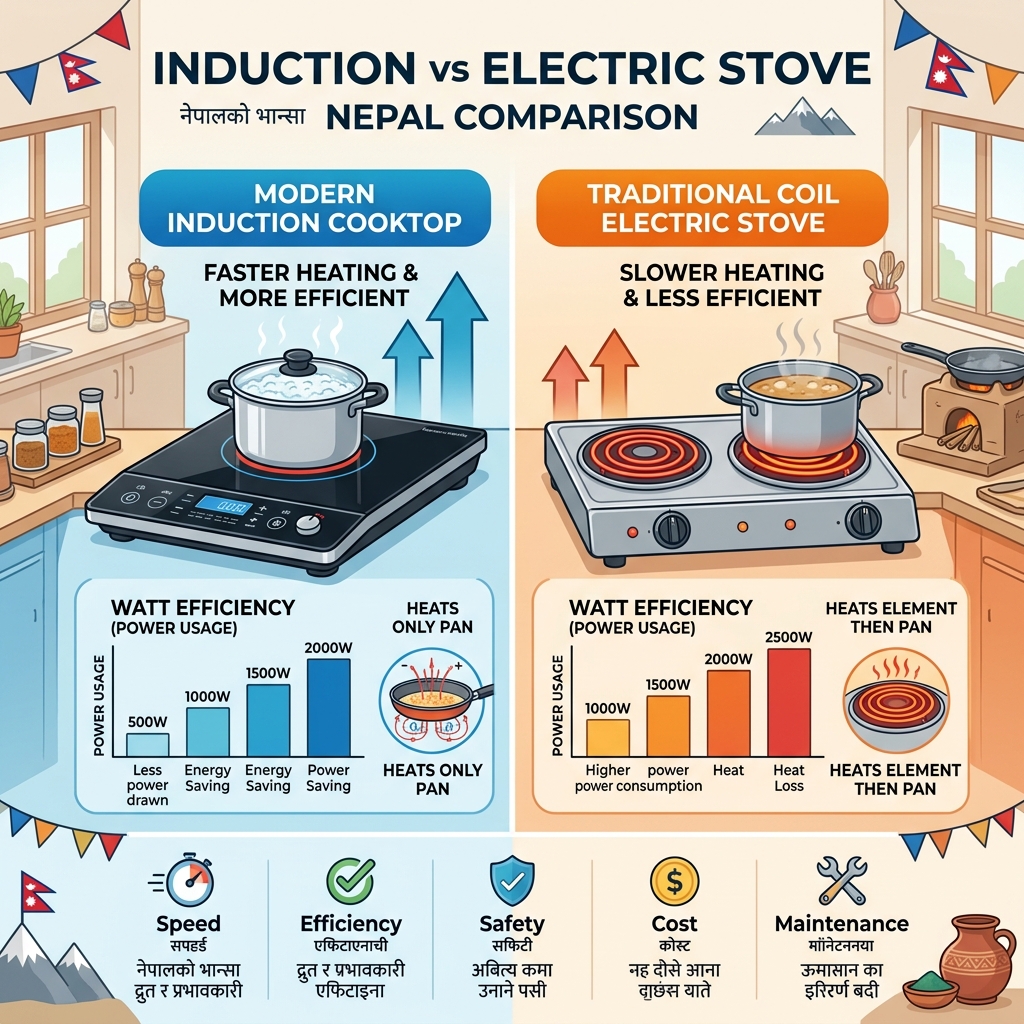
Induction stoves and electric stoves both use electricity, but they heat food through completely different mechanisms. Induction stoves generate an electromagnetic field that heats only the magnetic cookware — the glass stays cool. Traditional electric stoves heat a metal coil or ceramic plate that radiates heat upward — the entire cooking surface gets hot. In Nepal, “electric stove” most commonly refers to electric coil heaters (रु. 800 to रु. 2,000) or infrared cookers (रु. 3,900 to रु. 10,500), while “induction stove” specifically means electromagnetic cookers (रु. 2,999 to रु. 12,400).
Side-by-Side Comparison
| Factor | Induction Stove | Traditional Electric Stove | Infrared Cooker |
|---|---|---|---|
| Heating method | Electromagnetic field → heats cookware | Metal coil → radiates heat | Radiant coil → heats glass surface |
| Surface temp during cooking | 🟢 Cool glass | 🔴 Exposed hot coil | 🔴 Hot glass (300°C+) |
| Heating speed | Fast (4-5 min for 1L water) | Slow (8-12 min) | Medium (6-8 min) |
| Energy efficiency | 80-90% | 40-50% | 50-60% |
| Cookware requirement | Magnetic base only | Any cookware | Any flat-bottom |
| Monthly electricity (Nepal) | रु. 700 – रु. 1,200 | रु. 1,000 – रु. 1,800 | रु. 800 – रु. 1,400 |
| Safety | 🟢 Cool surface + child lock | 🔴 Exposed coil burn risk | 🔴 Hot glass burn risk |
| Price range (Nepal) | रु. 2,999 – रु. 12,400 | रु. 800 – रु. 2,000 | रु. 3,900 – रु. 10,500 |
| Durability | 2-5 years (mid-range+) | 1-3 years | 2-4 years |
Why the Confusion Exists in Nepal
Nepal buyers searching for “electric stove” often mean different things:
“Electric stove” = electric coil heater: The cheapest option (रु. 800 to रु. 2,000) — an exposed metal coil that heats up when powered. No glass surface, no safety features, no temperature control. These are commonly sold in local hardware shops across Nepal. They work with any pot but are slow, inefficient, and present a direct burn hazard from the exposed red-hot coil.
“Electric stove” = infrared cooker: A step above coil heaters — the coil is enclosed beneath a glass surface, providing a cleaner look. Infrared cookers (रु. 3,900 to रु. 10,500) heat the glass, which then heats the cookware. Works with all cookware types. See our infrared cooker guide for details.
“Electric stove” = induction cooker: The most advanced option — electromagnetic heating that is faster, more efficient, and safer. Requires magnetic cookware. This is what InductionStoveNepal specializes in.
When to Choose Induction Over Electric
Scenario 1: Daily Primary Cooking
Induction stoves are significantly better than electric coil heaters or infrared for daily cooking. A CG CGIC20D02 at रु. 4,600 boils water in 4-5 minutes versus 8-12 minutes on an electric coil. Over 3 meals daily, the speed difference saves 15-25 minutes of total cooking time. The energy efficiency gap (80-90% vs 40-50%) saves approximately रु. 300 to रु. 600 per month in electricity.
Scenario 2: Safety Priority
Induction’s cool glass surface and child lock eliminates the burn risk from exposed hot coils (electric heater) or hot glass surfaces (infrared). For Nepal households with children, the CG CGIC20D02 with child lock (रु. 4,600) is the safest electric cooking option available.
Scenario 3: Long-Term Cost
| Cost Over 2 Years | Electric Coil | Infrared | Induction |
|---|---|---|---|
| Stove purchase | रु. 1,500 | रु. 4,500 | रु. 4,600 |
| Cookware (if needed) | रु. 0 | रु. 0 | रु. 2,500 |
| 24 months electricity | रु. 24,000 – रु. 43,200 | रु. 19,200 – रु. 33,600 | रु. 16,800 – रु. 28,800 |
| Total 2-year cost | रु. 25,500 – रु. 44,700 | रु. 23,700 – रु. 38,100 | रु. 23,900 – रु. 35,900 |
Induction’s higher upfront cost (stove + cookware) is recovered within 12-18 months through lower monthly electricity consumption. By Year 2, induction is the cheapest option despite the initial cookware investment.
When Electric Coil or Infrared Makes Sense
Emergency / Backup Only
Electric coil heaters at रु. 800 to рु. 2,000 are acceptable as emergency backup stoves — kept stored and used only during rare power situations where a quick boil is needed. They should not be primary daily cooking appliances due to low efficiency, burn risk, and slow heating.
Extensive Aluminum Cookware + Budget Under रु. 4,000
Nepal families with significant aluminum cookware investment who cannot afford both an induction stove AND replacement cookware should consider infrared cookers (रु. 3,900+) as a first step. See our induction vs infrared comparison for the full analysis.
Frequently Asked Questions — Induction vs Electric
Is induction the same as electric?
Induction IS electric — it uses electricity as its power source. But the heating mechanism is fundamentally different. “Electric stove” in Nepal typically refers to coil heaters or infrared cookers that use resistive heating (electricity → heat in a coil → heat radiates outward). “Induction stove” uses electromagnetic heating (electricity → magnetic field → heat generated inside the cookware). Induction is a specific, more advanced type of electric cooking.
Why is induction more efficient than electric?
Electric coil heaters waste 50-60% of energy heating the air, the coil body, and the surrounding area. Induction transfers 80-90% of electrical energy directly into the cookware’s metal base through electromagnetic induction — almost no energy is lost to the surrounding environment. This is why induction costs less per month despite using the same electricity source.
Can I use an induction stove as a replacement for my electric coil heater?
An induction stove like the Baltra Active BIC-124 at रु. 2,999 replaces an electric coil heater in every function — boiling, frying, simmering — while adding digital temperature control, safety features, and 2x energy efficiency. The only additional requirement is magnetic cookware. Budget रु. 1,500 to ру. 4,000 for cookware if your current pots are aluminum.
Last updated: March 2026.
📞 Browse Induction Stoves at InductionStoveNepal | 🚚 Free Delivery Kathmandu Valley | 💵 COD Available
