
Induction Stove Buying Guide Nepal 2026
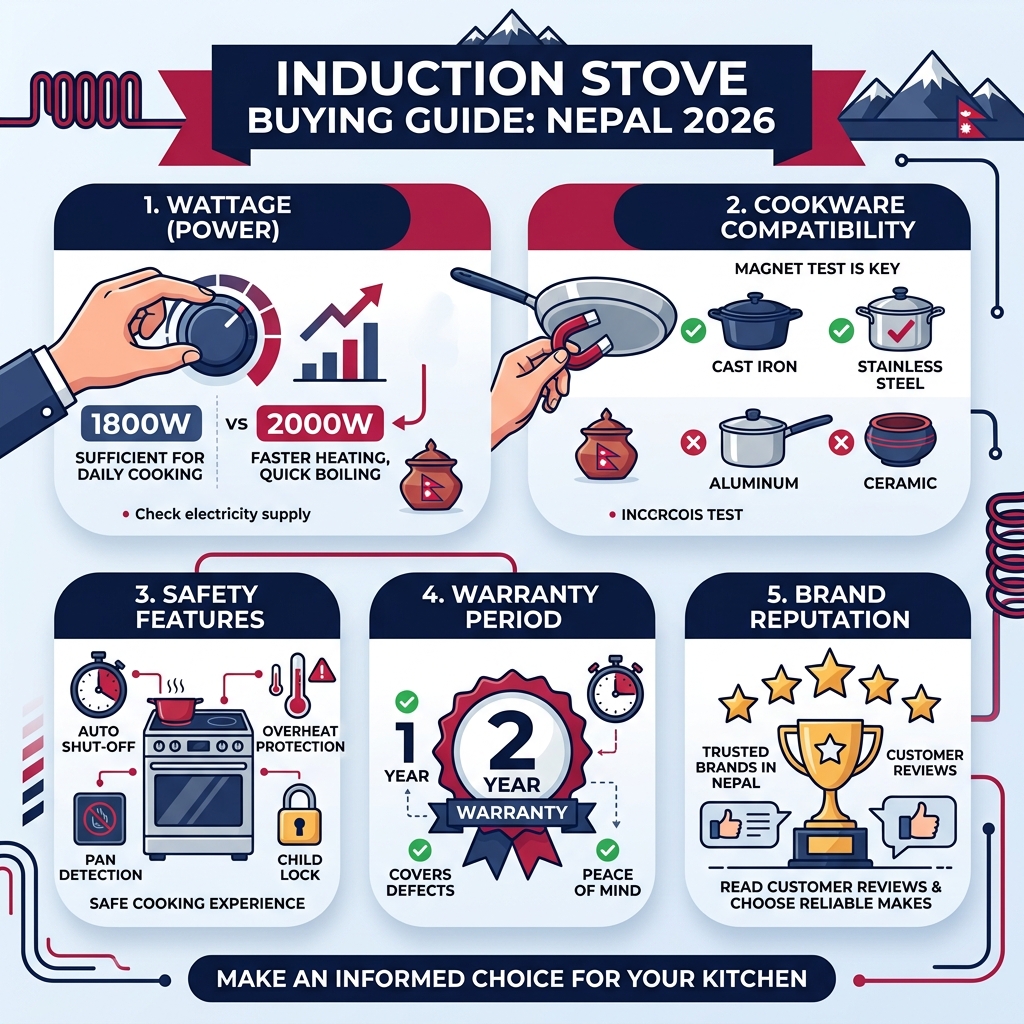
Choosing the right induction stove in Nepal comes down to five decisions: wattage (1500W or 2000W+), control type (push-button or touch), glass panel quality, brand warranty access, and budget tier (रु. 2,999 to रु. 10,999 for single burners). This guide covers every factor a Nepal buyer needs to make a confident purchase — without marketing jargon and without pushing the most expensive option. At InductionStoveNepal, we help customers choose the model that matches their cooking needs and budget — not the model with the highest commission.
Step 1: Decide Between Induction and Infrared
The first decision is choosing between induction and infrared — two different electric cooking technologies. The key difference: induction heats only magnetic cookware (steel, iron) through electromagnetic energy, keeping the glass cool. Infrared heats a radiant coil that gets the glass extremely hot, but works with all cookware including aluminum.
For Nepal buyers with extensive aluminum cookware, infrared avoids cookware replacement costs. For everyone else, induction is the better long-term investment — faster heating, lower electricity cost, and safer around children.
➡️ Full comparison: See our Induction vs Infrared Cooktop guide for the complete side-by-side analysis with Nepal pricing.
Step 2: Choose Your Wattage
Wattage determines how fast the induction stove heats food. Nepal buyers can choose between three wattage levels:
1500W — For Light Cooking and Small Pots
Models at 1500W (example: Kent Gem at रु. 4,200 to रु. 4,500) suit light cooking tasks — boiling water, simmering dal, reheating food. The lower wattage means slower heating: approximately 30 to 45 seconds longer to boil 1 liter of water compared to 2000W. The benefit is lower electricity draw — helpful in older Nepal apartments with 5-amp meters that may trip at higher wattage loads. Not recommended for pressure cooking with large pots.
[2000W — The Standard for Nepal](/induction-stove-wattage-guide/) Households
The 2000W rating is the most common power level across all major brands in Nepal — Baltra, CG, Prestige, Kent, Midea, and Pigeon. A 2000W induction stove handles all standard Nepal cooking: boiling rice, pressure cooking dal, frying tarkari, making roti on a tawa, and boiling water for tea. Approximately 90% of induction stoves sold in Nepal are 2000W models. Unless there is a specific reason to go higher or lower, 2000W is the correct choice for most Nepal households.
2200W — For Heavy Cooking and Large Families
Models at 2200W (CG Meridia at रु. 5,100 to रु. 6,200, Prestige PIC 6.1 V3 at रु. 7,400 to रу. 8,500) heat approximately 10 to 15% faster than 2000W models. The 200W difference is noticeable when using large pressure cookers (5+ liter capacity) for dal or when cooking for families of 5+ members where speed matters. The price premium for 2200W over 2000W is approximately रу. 1,000 to рु. 2,000, and the monthly electricity cost increases by roughly рु. 50 to ру. 100.
Step 3: Choose Your Control Type
Push-Button Controls
Push-button induction stoves have raised physical buttons — typically with temperature +/- controls, preset mode buttons, and an on/off switch. Push-button models cost рु. 500 to рु. 1,500 less than touch equivalents. The raised buttons are easier to press with wet or oily hands during cooking. The disadvantage: food spills collect around and under the buttons, making push-button models harder to clean.
Available push-button models in Nepal: Baltra Active BIC-124 (ру. 2,999), entry-level models from Pigeon and Bajaj.
Touch Controls
Touch-controlled induction stoves have a flat, smooth glass surface with printed touch-sensitive zones. Touch panels are easier to clean — a single wipe across the flat surface removes all spills. Touch controls look more premium and modern. The disadvantage: some users find touch panels less responsive when fingers are wet or oily. Touch panels also cannot be operated while wearing thick cooking gloves.
Available touch models in Nepal: Baltra Prima Pro (ру. 4,025+), CG CGIC20C05 (ру. 4,100+), Prestige PIC series (рु. 5,200+), Philips HD4928 (ру. 10,349), Kent (ру. 4,200+).
Our recommendation: Touch controls for any induction stove used as the primary daily cooking appliance. The cleaning advantage alone justifies the price premium because the stove is wiped down after every cooking session.
Step 4: Understand Glass Panel Quality
The glass panel is the most fragile part of an induction stove and the most common failure point. Nepal buyers should understand the three glass types available:
Standard Tempered Glass
Found on budget models (Baltra Active, entry-level CG). Adequate for daily use but more prone to scratches from sliding cookware and less resistant to thermal shock (rapid temperature changes). Most affordable replacement cost if cracked.
Micro-Crystal Glass
Found on mid-range models (Baltra Prima Pro, some CG models). Better scratch resistance, better heat distribution, and longer lifespan under daily cooking stress. The surface feels smoother than standard glass and cleans easier.
Ceramic Glass (Vitro-Ceramic)
Found on premium models (CG Meridia, Prestige PIC 6.1 V3, Philips). Highest scratch resistance, best thermal shock tolerance, and longest expected lifespan. Most expensive to replace if cracked.
Nepal-specific glass tip: Always lift cookware off the glass surface — never drag pans. Nepal’s heavier cast iron and steel cookware can scratch even ceramic glass if dragged repeatedly. Keep the glass surface clean of food particles before placing pots — burnt grain particles between the pot and glass surface cause permanent scratches.
Step 5: Choose Your Brand Based on Warranty Value
In Nepal, warranty support quality varies dramatically between brands — this is often more important than the stove’s feature list.
| Brand | Warranty Type | Service Center Coverage | Claim Process |
|---|---|---|---|
| CG | Domestic warranty — CG service centers | Kathmandu, Pokhara, Biratnagar, Bharatpur, Butwal, other major cities | Walk in to any CG service center with warranty card |
| Baltra | Importer warranty — through authorized dealer | Primarily Kathmandu, limited outside Valley | Contact importer, may require shipping unit |
| Prestige | Importer warranty — through Nepal distributor | Limited service points | Contact distributor, process varies |
| Philips | Authorized service partner warranty | Kathmandu, select cities | Contact authorized service partner |
| Kent | Importer warranty | Limited | Contact importer |
| Yasuda | Domestic warranty — Yasuda Nepal | Nepal-wide through Yasuda network | Walk in to Yasuda service center |
Our recommendation for Nepal: If convenient warranty processing is your priority, choose CG or Yasuda — both are Nepali companies with domestic service networks. If you live in Kathmandu Valley where all brand importers have offices, any brand works because you can access service easily.
Step 6: Set Your Budget
Most Nepal families get the best value between рū. 4,000 and рū. 5,500 — this tier includes touch controls, better glass, and adequate build for daily cooking. Spending above рū. 6,000 on a single burner is justified only for heavy daily use as the household’s sole cooking method.
➡️ Full price breakdown: See our Induction Stove Price in Nepal guide for every model’s price by tier with platform sources.
➡️ Budget picks: See Best Induction Stove Under рū. 5,000 for the top budget options.
➡️ Top 10 picks: See Best Induction Stove Nepal 2026 for our complete ranked recommendations.
Common Mistakes Nepal Buyers Make
Mistake 1: Buying Without Checking Cookware Compatibility
The most common mistake — buying an induction stove and discovering that existing aluminum cookware does not work. Always do the magnet test on your cookware before purchasing. Budget an additional ру. 1,500 to ру. 4,000 for cookware if your existing pots fail the magnet test.
Mistake 2: Choosing by Price Only
The cheapest induction stove (ру. 2,999) delivers the same wattage as mid-range models but uses lower-quality components — thinner glass, generic IGBT chips, and fewer safety features. For daily primary cooking, investing ру. 1,000 to ру. 2,000 more for a mid-range model is a better long-term decision.
Mistake 3: Ignoring Electrical Capacity
A 2000W induction stove draws ~9 amps. Running it alongside a geyser (2000W) and a microwave (1000W) simultaneously on a 5-amp circuit will trip the breaker. Check your meter capacity and plan cooking around other high-draw appliances.
Mistake 4: Not Keeping the Warranty Card
Nepal warranty claims without documentation are routinely rejected. Keep the warranty card, purchase receipt, and packaging for at least 12 months after purchase.
Mistake 5: Expecting Induction During Power Outages
Induction stoves require continuous electricity — they do not work during outages. Nepal’s load shedding has largely ended in urban areas, but brief power interruptions still occur. Keep a backup LPG stove or plan meals around power availability if your area experiences regular cuts.
Frequently Asked Questions — Induction Buying Guide
What is the best wattage for induction stove in Nepal?
2000W is the best wattage for most Nepal households. This rating handles all standard cooking tasks — pressure cooking dal, boiling rice, frying tarkari, and making roti. Higher wattage (2200W) is beneficial only for large pressure cookers and heavy-volume cooking. Lower wattage (1500W) is suitable only for light cooking and small pots.
Is a branded induction stove worth the extra cost?
Branded induction stoves from CG, Baltra, Prestige, and Philips cost ру. 1,000 to ру. 7,000 more than unbranded Chinese models — but offer warranty support, replacement part availability, and consistent build quality. Unbranded models (Sokany, Shine, Osaka Power at ру. 2,800 to ру. 3,000) have limited or no local warranty coverage in Nepal. For a daily-use cooking appliance, the warranty access alone justifies choosing a branded model.
How do I know if my cookware works on induction?
Hold a refrigerator magnet to the bottom of each pot and pan. If the magnet sticks firmly, the cookware works on induction. If the magnet slides off or does not stick, the cookware is not compatible. Stainless steel and cast iron always pass. Aluminum, copper, and glass always fail. Some multi-layer cookware with a steel bottom plate also passes — check the base with a magnet.
Should I buy online or from a physical store?
Both options are viable in Nepal. Online platforms (Daraz, CG Digital, InductionStoveNepal) offer price comparison convenience, COD payment, and doorstep delivery. Physical stores allow hands-on inspection before purchase and immediate warranty card verification. Our recommendation: compare prices online, then buy from whichever channel offers the best price with clear warranty documentation.
Last updated: March 2026. All prices verified from Daraz Nepal and authorized retailers.
📞 Order Now at InductionStoveNepal | 🚚 Free Delivery Kathmandu Valley | 💵 COD Available | 🛡️ 1-Year Warranty
