
Induction vs Infrared Cooktop Nepal 2026
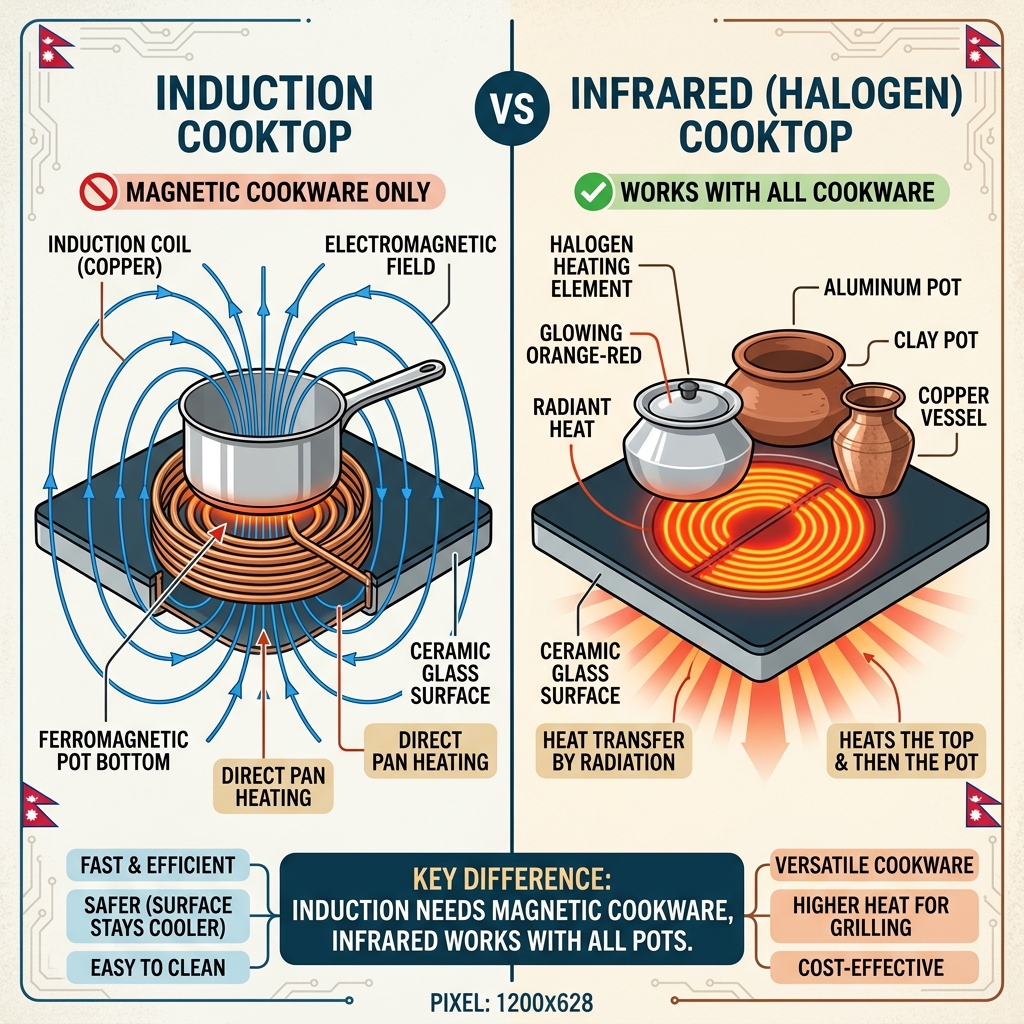
Induction cooktops heat faster, use less electricity, and keep the glass surface cool — but require magnetic cookware (рū. 1,500+ replacement cost). Infrared cooktops work with all existing Nepal cookware including aluminum and copper — but heat slower, use more electricity, and leave the glass dangerously hot for 10 to 15 minutes after cooking. The right choice for Nepal buyers depends on existing cookware and safety priorities, not on which technology is “better” in absolute terms.
Side-by-Side Comparison — Every Factor That Matters in Nepal
| Factor | Induction Cooktop | Infrared Cooktop |
|---|---|---|
| Heating method | Electromagnetic — heats cookware directly | Radiant coil — heats glass, then cookware |
| Cookware compatibility | Magnetic base only (steel, iron) | All flat-bottom (aluminum, copper, glass, steel) |
| Surface temperature during cooking | 🟢 Relatively cool | 🔴 Extremely hot (300°C+) |
| Surface temperature after cooking | 🟢 Cool within seconds | 🔴 Hot for 10-15 minutes |
| Heating speed (1L water) | ~4-5 minutes | ~6-8 minutes |
| Energy efficiency | Higher — 80-90% energy to cookware | Lower — 50-60% energy to cookware |
| Monthly electricity (Nepal) | рū. 700 – рū. 1,200 | рū. 800 – рū. 1,400 |
| Child safety | 🟢 Cool surface + child lock | 🔴 Hot surface — burn risk |
| Price range (Nepal) | рū. 2,999 – рū. 12,400 | рū. 3,900 – рū. 10,500 |
| Cheapest option (Nepal) | Baltra Active BIC-124 рū. 2,999 | Yasuda YS-IFMT20 рū. 3,900 |
| Cookware replacement cost | рū. 1,500 – рū. 4,000 | рū. 0 (existing cookware works) |
| Total switching cost | рū. 4,499 – рū. 14,999+ | рū. 3,900 – рū. 10,500 |
When to Choose Induction — Nepal Buyer Scenarios
Scenario 1: New Kitchen Setup (рū. 0 Existing Cookware Investment)
Nepal families building a new kitchen from scratch — new marriage, new house, new apartment — should choose induction because cookware cost is already budgeted. Buying induction-compatible steel cookware from the start costs only marginally more than aluminum equivalents and provides long-term electricity savings of рū. 100 to рū. 200 per month over infrared.
Scenario 2: Household with Children
The CG CGIC20D02 induction cooktop with child lock (рū. 4,600 to рū. 5,400) is significantly safer than any infrared model for Nepal households with children under 10 years old. Induction’s cool glass surface cannot burn a child who touches it during or immediately after cooking. Infrared glass surfaces at 300°C+ during cooking and residual temperatures above 100°C for 10+ minutes after cooking present a genuine burn hazard.
Scenario 3: Energy-Conscious Household
Induction stoves deliver 80-90% of input electricity to the cookware as cooking heat. Infrared stoves deliver only 50-60%. Over 12 months, this efficiency difference translates to approximately рū. 1,200 to рū. 2,400 in additional electricity savings with induction — recovered across the first year of use.
When to Choose Infrared — Nepal Buyer Scenarios
Scenario 1: Extensive Aluminum Cookware (рū. 3,000+ Replacement Cost)
Nepal households with рū. 3,000 or more invested in aluminum pressure cookers, dekchis, and kadhais face a significant switching cost with induction. Infrared at рū. 3,900 (Yasuda single-burner) requires zero cookware investment — total switching cost is рū. 3,900 vs рū. 4,499+ for induction (stove + cookware).
Scenario 2: Cooking Variety Including Grilling
Baltra infrared models with grill attachments (рū. 4,575 to рū. 5,275) allow grilling momo, vegetables, and kebabs directly on the cooking surface — a function no induction stove offers. For Nepal households that regularly prep grilled items alongside standard cooking, infrared with grill attachment provides dual functionality.
Scenario 3: Gradual Transition from LPG
Nepal families wanting to test electric cooking with zero additional investment beyond the stove itself should start with infrared. Use existing aluminum cookware on infrared immediately, then gradually purchase induction-compatible steel items over 6 to 12 months. Once sufficient steel cookware is accumulated, switch the infrared unit for an induction stove — or keep both.
Total Cost of Ownership — 1-Year Nepal Comparison
| Cost Component | Induction | Infrared |
|---|---|---|
| Stove purchase (mid-range) | рū. 4,600 (CG CGIC20D02) | рū. 4,575 (Baltra infrared) |
| Cookware replacement | рū. 2,500 (basic set + pressure cooker) | рū. 0 |
| 12 months electricity | рū. 8,400 – рū. 14,400 | рū. 9,600 – рū. 16,800 |
| 1-Year Total Cost | рū. 15,500 – рū. 21,500 | рū. 14,175 – рū. 21,375 |
| 2-Year Total Cost | рū. 23,900 – рū. 35,900 | рū. 23,775 – рū. 38,175 |
In Year 1, infrared has a slight cost advantage due to zero cookware investment. By Year 2, induction’s monthly electricity savings overtake the initial cookware cost — making induction cheaper over the long term as the efficiency gap compounds monthly.
InductionStoveNepal Recommendation
Nepal families should choose based on their actual situation, not on which technology is “superior”:
| Your Situation | Our Recommendation | Specific Model |
|---|---|---|
| New kitchen, no existing cookware | Induction | CG CGIC20D02 рū. 4,600 + steel cookware set |
| Young children at home | Induction | CG CGIC20D02 (child lock) рū. 4,600 |
| Heavy aluminum cookware invested | Infrared | Yasuda YS-IFMT20 рū. 3,900 |
| Want to grill momo/kebabs | Infrared | Baltra infrared with grill рū. 4,575 |
| Budget-conscious, minimal cookware | Start infrared, transition later | Yasuda рū. 3,900 now → induction later |
| Maximum energy savings | Induction | Any 2000W model рū. 4,000+ |
At InductionStoveNepal, we carry both induction and infrared cookers and recommend based on each customer’s cookware and cooking needs — not on commission or margin.
Frequently Asked Questions — Induction vs Infrared Nepal
Can I use both induction and infrared in my kitchen?
Many Nepal families keep both — an induction stove for daily cooking with steel cookware and an infrared cooker for specific tasks requiring aluminum or copper pots. This dual-stove approach costs approximately рū. 7,000 to рū. 9,000 total (one of each) and provides maximum flexibility.
Which uses less electricity?
Induction uses approximately 10-20% less electricity than infrared for the same cooking task due to higher energy transfer efficiency. Over a year, this translates to approximately рū. 1,200 to рū. 2,400 in savings — approximately one month of free cooking per year with induction.
Is infrared safer than induction?
Infrared is less safe than induction due to the hot glass surface that retains dangerous temperatures for 10 to 15 minutes after cooking. Induction’s cool glass and child lock option make it the safer technology for Nepal households with children. Both are significantly safer than LPG gas stoves due to the absence of open flame and gas leak risk.
Last updated: March 2026. Prices verified from Daraz Nepal and authorized retailers.
📞 Order at InductionStoveNepal | 🚚 Free Delivery Kathmandu Valley | 💵 COD Available | 🛡️ 1-Year Warranty
